
Introduction
Choosing the right mobile app framework is one of the most important decisions in app development.
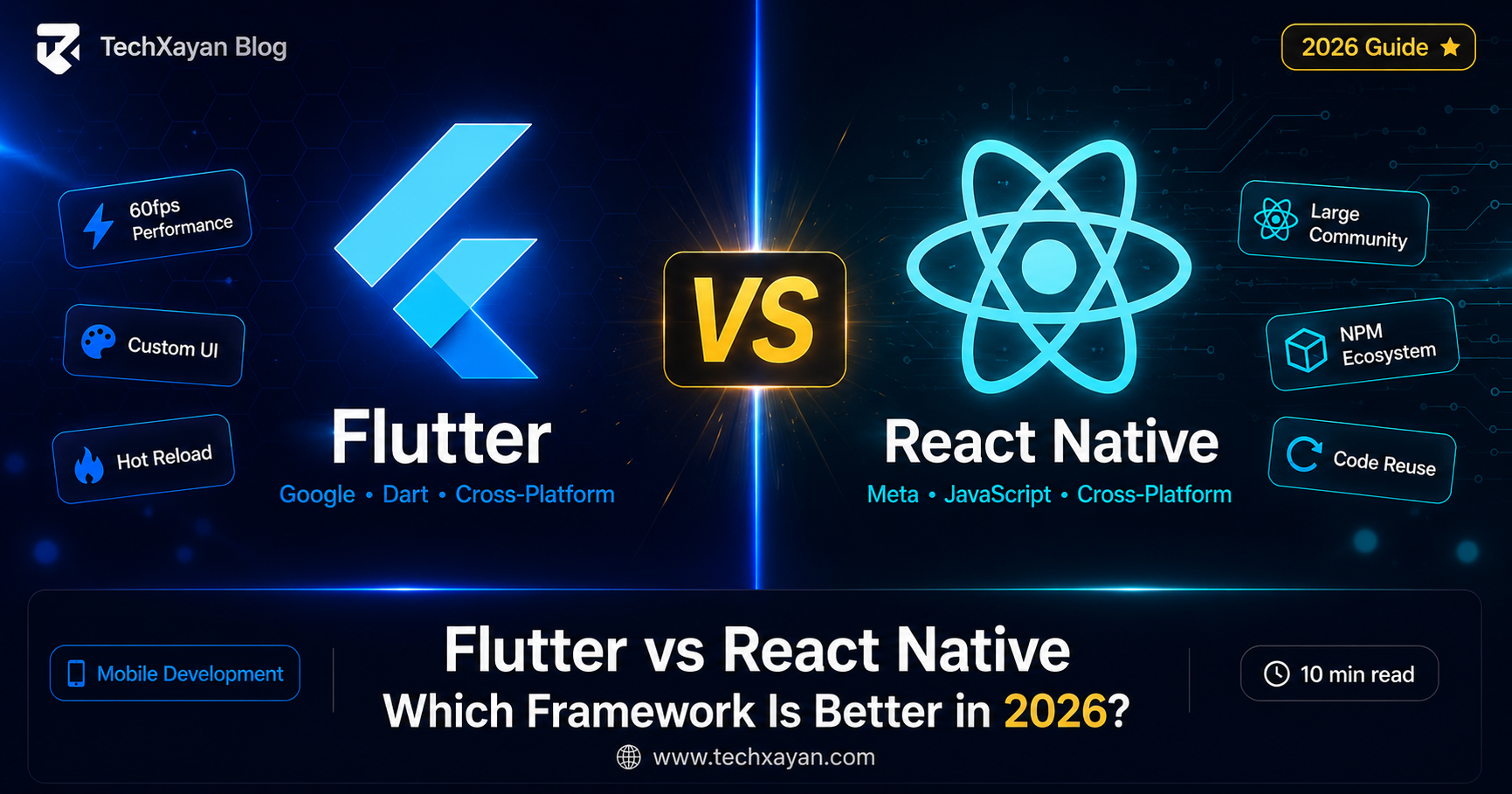
Two of the most popular cross-platform frameworks today are Flutter and React Native. Both allow developers to build Android and iOS apps using a single codebase, but they differ significantly in performance, UI, and development experience.
This guide compares Flutter and React Native in 2026.
What Is Flutter?
Flutter is a UI toolkit developed by Google for building fast and beautiful applications using the Dart programming language.
Key Advantages:
High performance
Beautiful UI
Strong customization
Fast rendering
What Is React Native?
React Native is a framework developed by Meta that uses JavaScript and React to create mobile applications.
Key Advantages:
Large community
JavaScript ecosystem
Faster learning curve for web developers
Performance Comparison
Flutter
Flutter delivers near-native performance because it uses its own rendering engine.
React Native
React Native relies on a bridge between native components and JavaScript, which can affect performance in complex applications.
Winner: Flutter
UI and Design
Flutter provides highly customizable widgets and consistent UI across platforms.
React Native depends more on native components.
Winner: Flutter
Development Speed
React Native can be faster for developers already experienced with JavaScript and React.
Flutter offers faster UI building with hot reload and pre-built widgets.
Winner: Tie
Scalability
Flutter is highly scalable for enterprise-level applications and modern startups.
React Native also supports scalability but may require more native integrations for complex apps.
Winner: Flutter
Which One Should You Choose?
Choose Flutter If:
You want excellent UI/UX
You need high performance
You want scalable architecture
Choose React Native If:
Your team already uses JavaScript
You want to reuse React knowledge
Your project is relatively simple
Final Verdict
In 2026, Flutter continues to dominate for modern, scalable, and visually rich applications.
Businesses looking for performance, beautiful design, and long-term scalability often choose Flutter for mobile app development.
Conclusion
Both Flutter and React Native are powerful frameworks, but Flutter offers stronger performance and UI flexibility for most modern applications.
To develop high-quality Flutter applications, visit TechXayan Official Website
.
Choosing the right mobile app framework is one of the most important decisions in app development.
Two of the most popular cross-platform frameworks today are Flutter and React Native. Both allow developers to build Android and iOS apps using a single codebase, but they differ significantly in performance, UI, and development experience.
This guide compares Flutter and React Native in 2026.
What Is Flutter?
Flutter is a UI toolkit developed by Google for building fast and beautiful applications using the Dart programming language.
Key Advantages:
High performance
Beautiful UI
Strong customization
Fast rendering
What Is React Native?
React Native is a framework developed by Meta that uses JavaScript and React to create mobile applications.
Key Advantages:
Large community
JavaScript ecosystem
Faster learning curve for web developers
Performance Comparison
Flutter
Flutter delivers near-native performance because it uses its own rendering engine.
React Native
React Native relies on a bridge between native components and JavaScript, which can affect performance in complex applications.
Winner: Flutter
UI and Design
Flutter provides highly customizable widgets and consistent UI across platforms.
React Native depends more on native components.
Winner: Flutter
Development Speed
React Native can be faster for developers already experienced with JavaScript and React.
Flutter offers faster UI building with hot reload and pre-built widgets.
Winner: Tie
Scalability
Flutter is highly scalable for enterprise-level applications and modern startups.
React Native also supports scalability but may require more native integrations for complex apps.
Winner: Flutter
Which One Should You Choose?
Choose Flutter If:
You want excellent UI/UX
You need high performance
You want scalable architecture
Choose React Native If:
Your team already uses JavaScript
You want to reuse React knowledge
Your project is relatively simple
Final Verdict
In 2026, Flutter continues to dominate for modern, scalable, and visually rich applications.
Businesses looking for performance, beautiful design, and long-term scalability often choose Flutter for mobile app development.
Conclusion
Both Flutter and React Native are powerful frameworks, but Flutter offers stronger performance and UI flexibility for most modern applications.
To develop high-quality Flutter applications, visit TechXayan Official Website
.